Overview
Working with a lean, 2-person founding team, the goal was to scale an early-stage concept into a market-ready platform. In just 4 months, I led the transition from foundational research to a development-ready product, transforming a manual, 5-hour document retrieval process into a seamless, 1-click experience. A developer audit later confirmed the prototype cut an estimated 35–45% off development time compared to a build-from-scratch approach — the founders shipped to development with a working foundation, not a set of screens.
The business context
Construction project management generates enormous volumes of documentation — contracts, letters, work diaries, technical reports, geotech surveys, regulatory notices — spread across every project, every team, and every phase of a build. When something goes wrong on site, or when a client sends a formal letter demanding answers, the people responsible for responding have to manually search through that documentation to build their case. This takes days. The response goes out weeks later.
The consequences compound. A construction company that can't demonstrate a complete, traceable record is exposed legally and operationally — the same problems keep recurring with no institutional mechanism for learning.
Constructer AI was founded to solve this. The founders had identified the problem from industry experience and had built a minimal prototype — barely functional, enough to demonstrate the idea — but had no clear picture of who the product was really for, what the workflow should look like, or what needed to be built first.
Research and discovery
I ran moderated user interviews with senior professionals from Cetenco Engenharia — a São Paulo-based civil engineering firm with over 90 years of history. The interviews surfaced two distinct and equally damaging pain points:
Finding #1 - Response drafting took 5 hours per formal letter.
The Legal Manager described spending five hours researching prior correspondence, contracts, meeting minutes, and work diaries before she could draft a single formal response.
"[the tool] Should allow us to act as a filter for information, which is a strategic role. Deciding what to include and what to exclude, rather than an operational role."
FC, Business Legal Manager
Finding #2 - Issue origins took 2 days to trace.
The Contractual Manager described spending two days reconstructing the history of a problem before he could understand its full impact on the project timeline and contract.
"Not having clarity about the beginning, middle, and end of things creates the other problems. If you don't have complete mastery of the problem, you may not be able to know how it impacts over time."
RM, Contractual Administration Manager
In parallel, I conducted a full competitor analysis across 16 platforms. All five direct competitors had document AI and conversational agents — none tied those capabilities into an executable workflow. That gap was Constructer AI's opening.
Key decisions
Two user types, one product.
The two pain points — drafting formal responses and tracing issue origins — were experienced through completely different lenses, but ran on the same underlying data: the same contracts, the same project documentation, the same issue history. Rather than designing for one user and ignoring the other, I built distinct views and workflows for both, unified by a shared data model. That single decision is what produced the 5-hour-to-1-click outcome. A narrower scope would have produced a narrower result.
The AI agent executes workflows. It doesn't just answer questions.
Every one of the five direct competitors had conversational AI for document retrieval. That was the table stake — not the differentiator. I designed the AI Agent as an orchestrator: it takes a query, cross-references live issue data, and produces a structured, actionable output — a draft response, a traced issue timeline, a linked clause. The distinction between retrieving information and completing a step in a workflow became the product's primary differentiator and the clearest demonstration of what AI-native construction tooling could actually look like.
Scope to the two most expensive problems.
Cross-project organisational learning was validated as genuine but explicitly deferred to a future phase. A tighter MVP was a faster MVP, and a faster MVP generated the data the future roadmap depended on.
What was delivered
A fully working React prototype spanning three core modules — AI Agent, Issues & Blockers, and the main Dashboard — designed around more than ten real‑world workflows for two distinct user types. It shipped with a foundational, scalable design system behind it, giving the development team a running product they could extend rather than reinvent. That system was built to WCAG 2.2 AA from the outset — colour contrast, keyboard support, and screen reader labelling checked component by component.
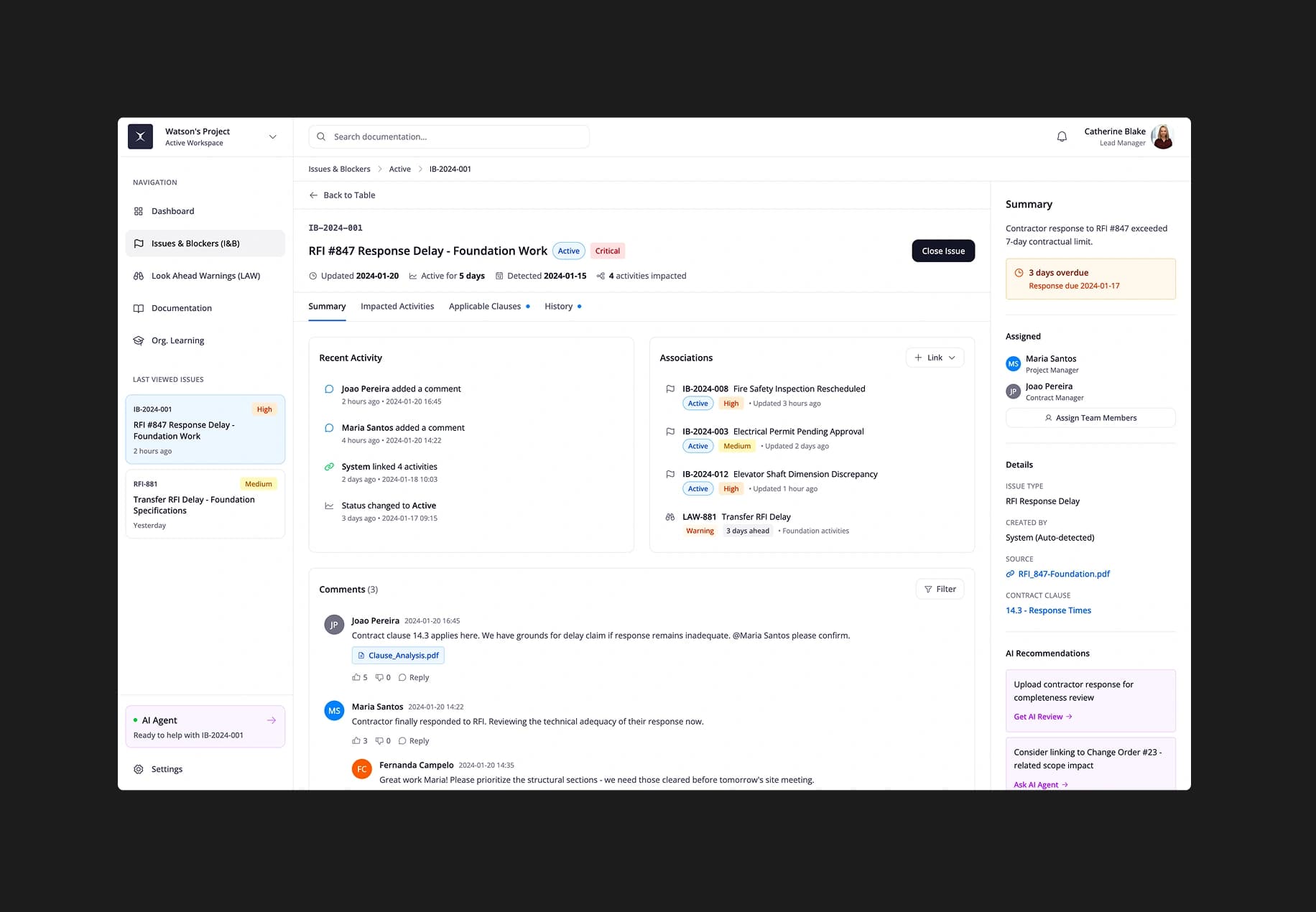
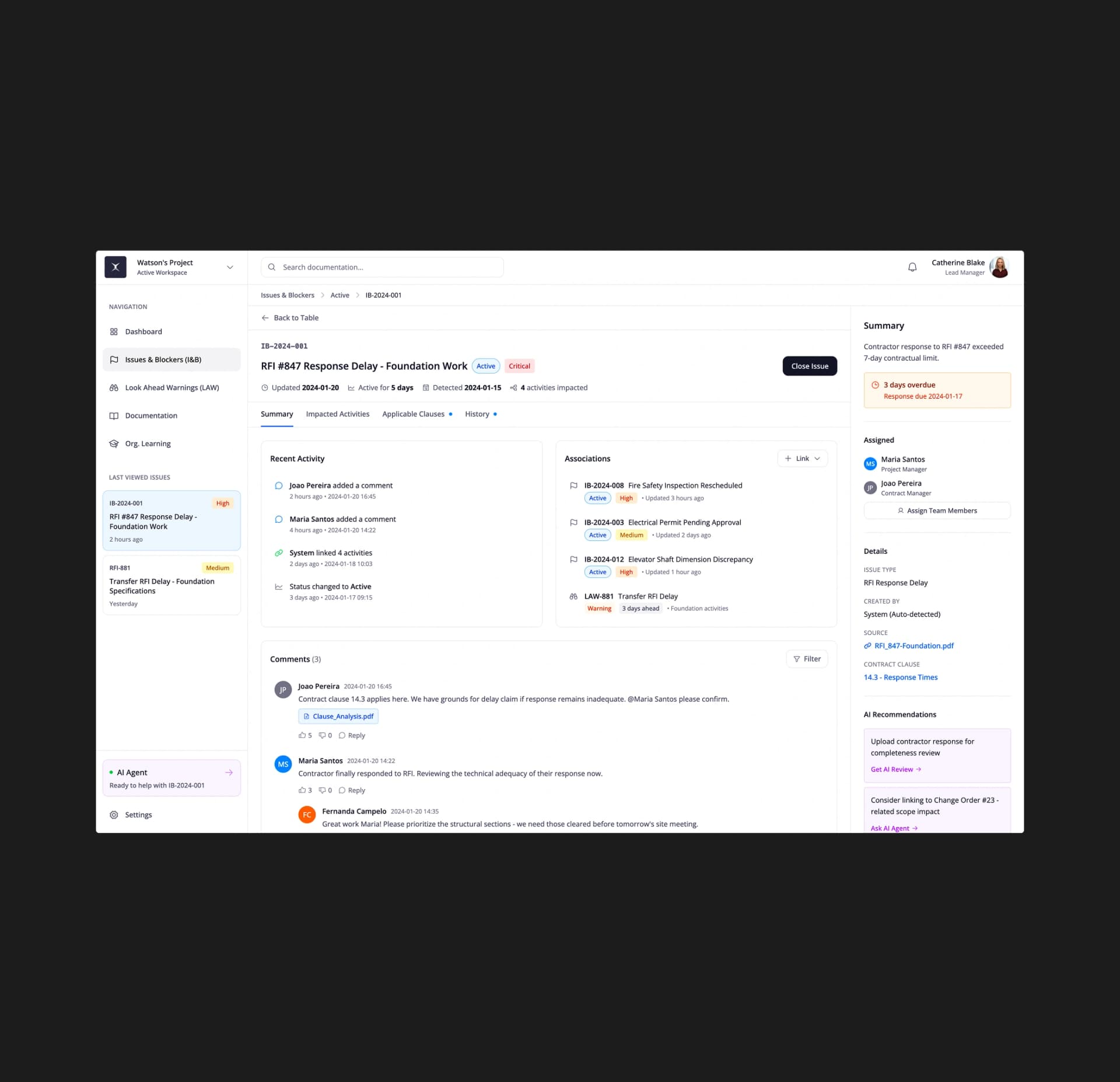
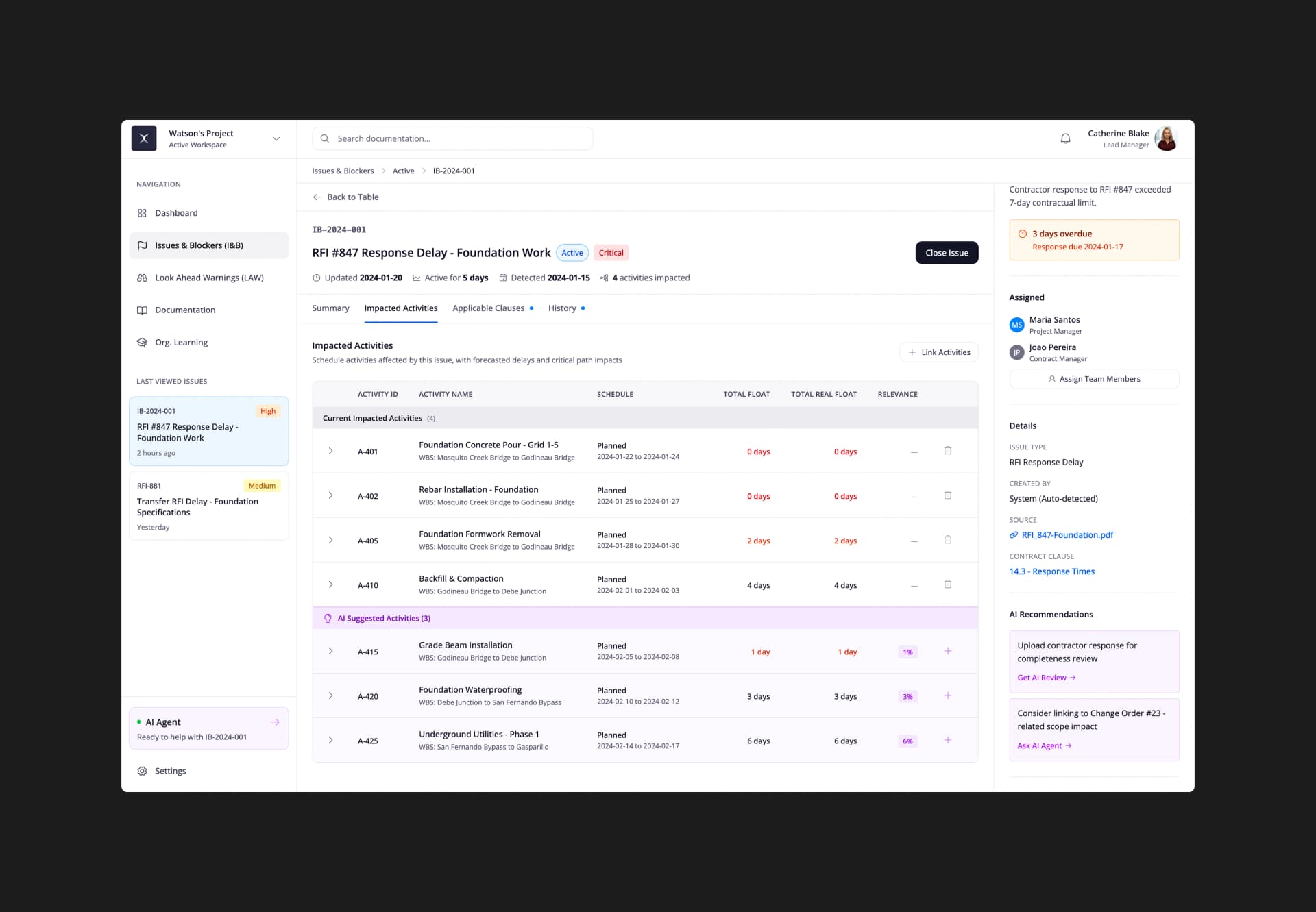
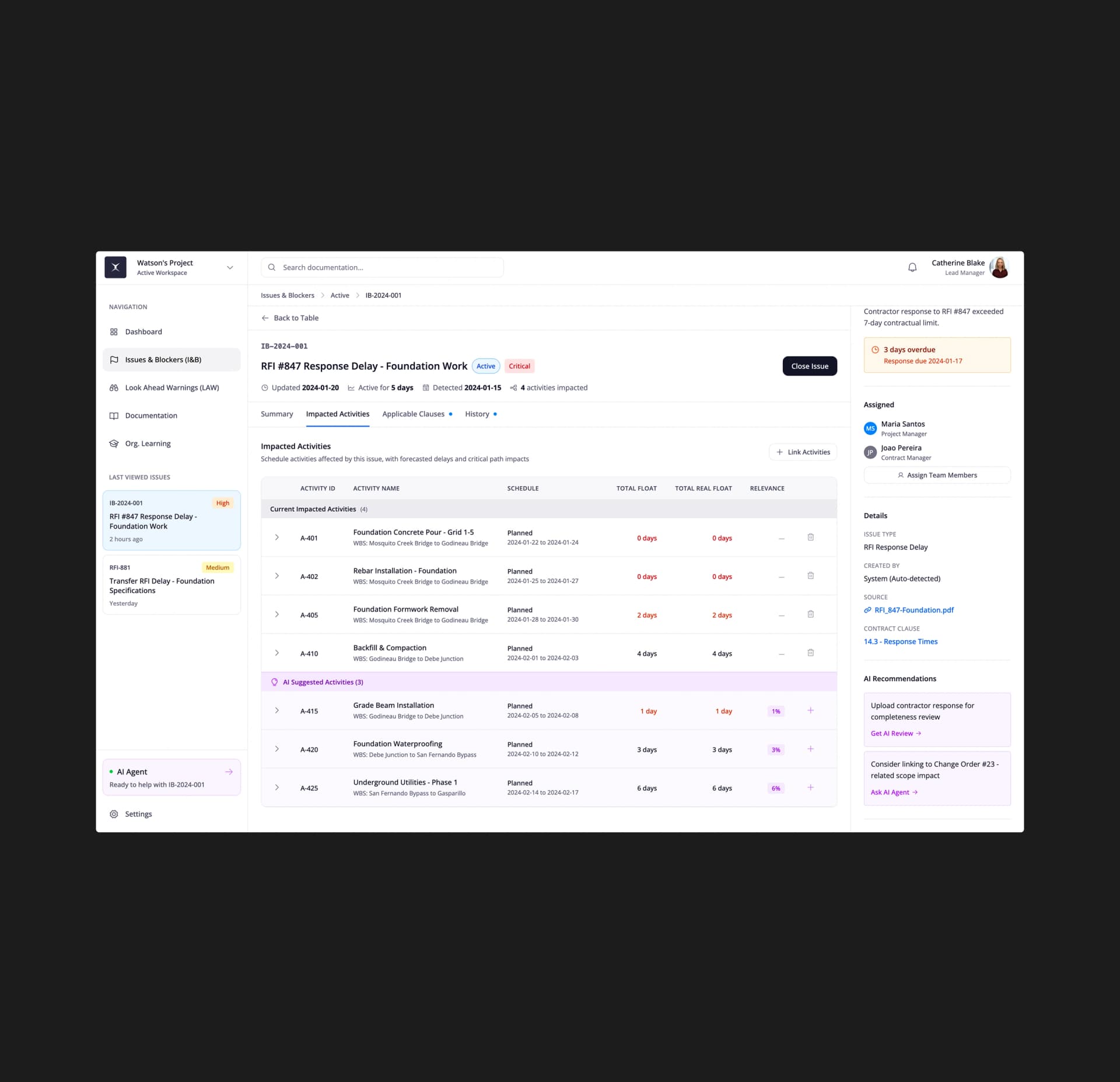
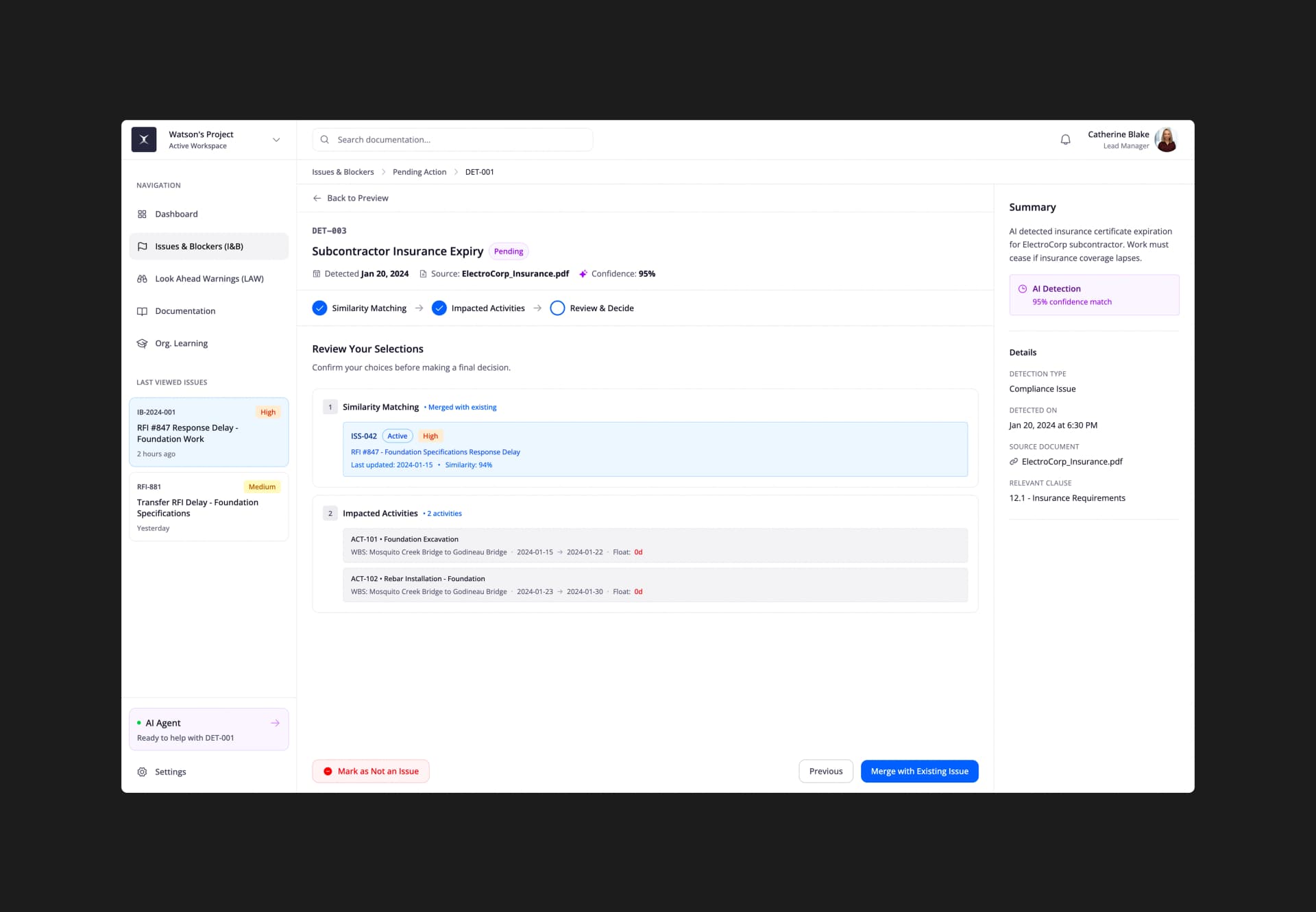
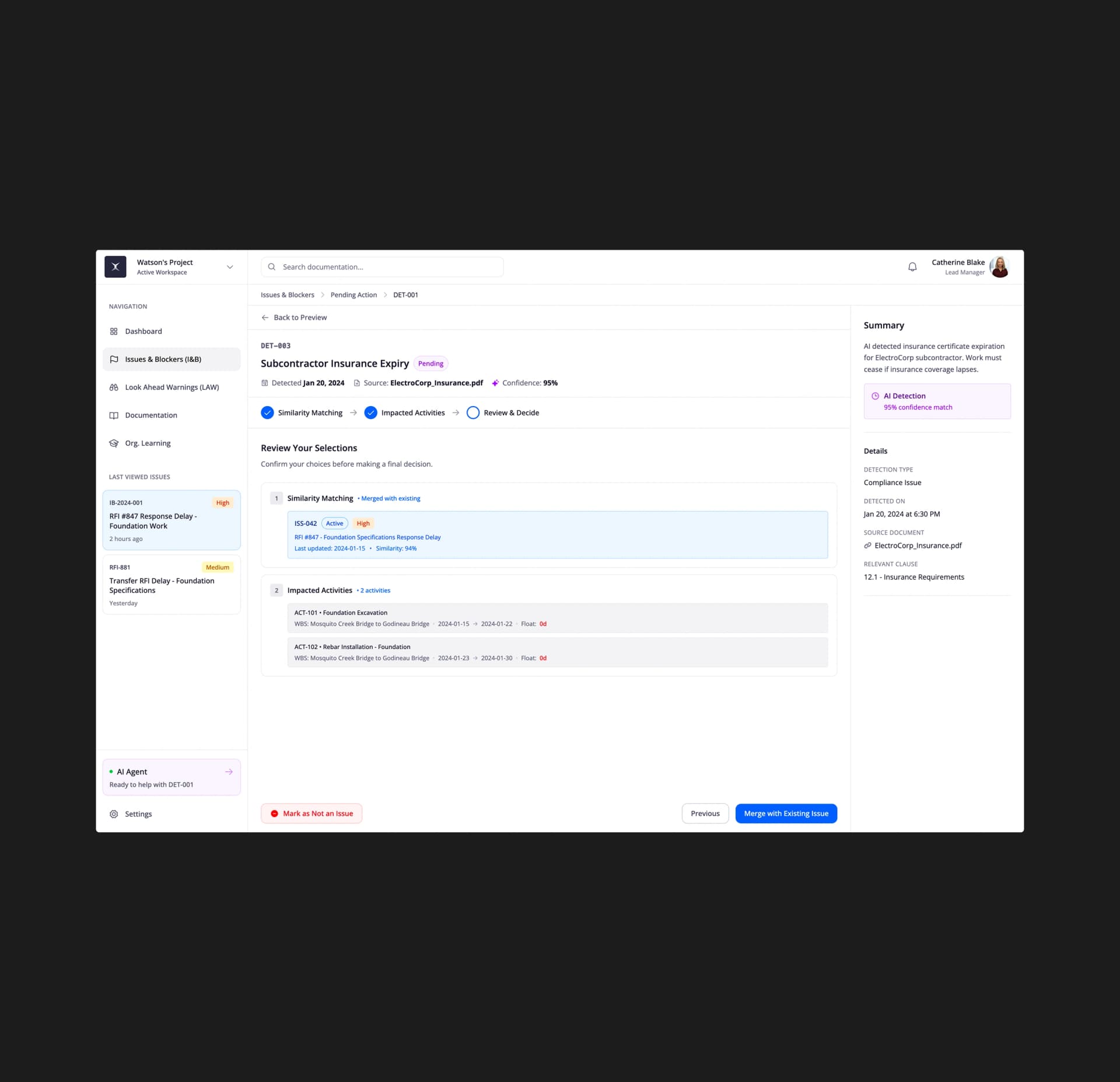
Issues & Blockers — The full lifecycle of a construction risk event, from first detection to resolution. Issues are surfaced automatically from project documentation and linked to their origin clauses and prior correspondence. Each issue carries a full activity timeline and a direct connection to the people responsible for resolving it — so nothing disappears into email threads, and no one loses context when the team changes.
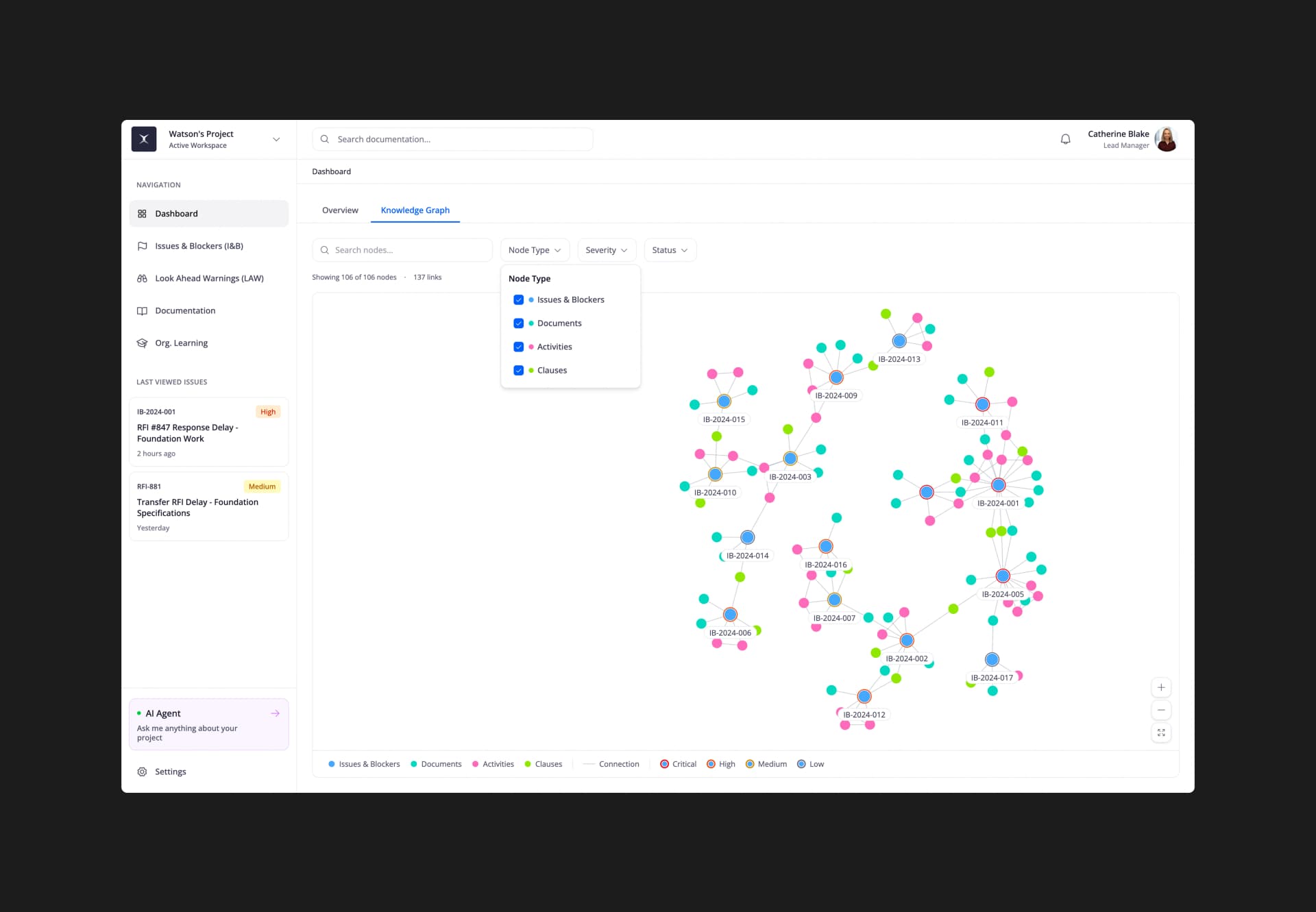
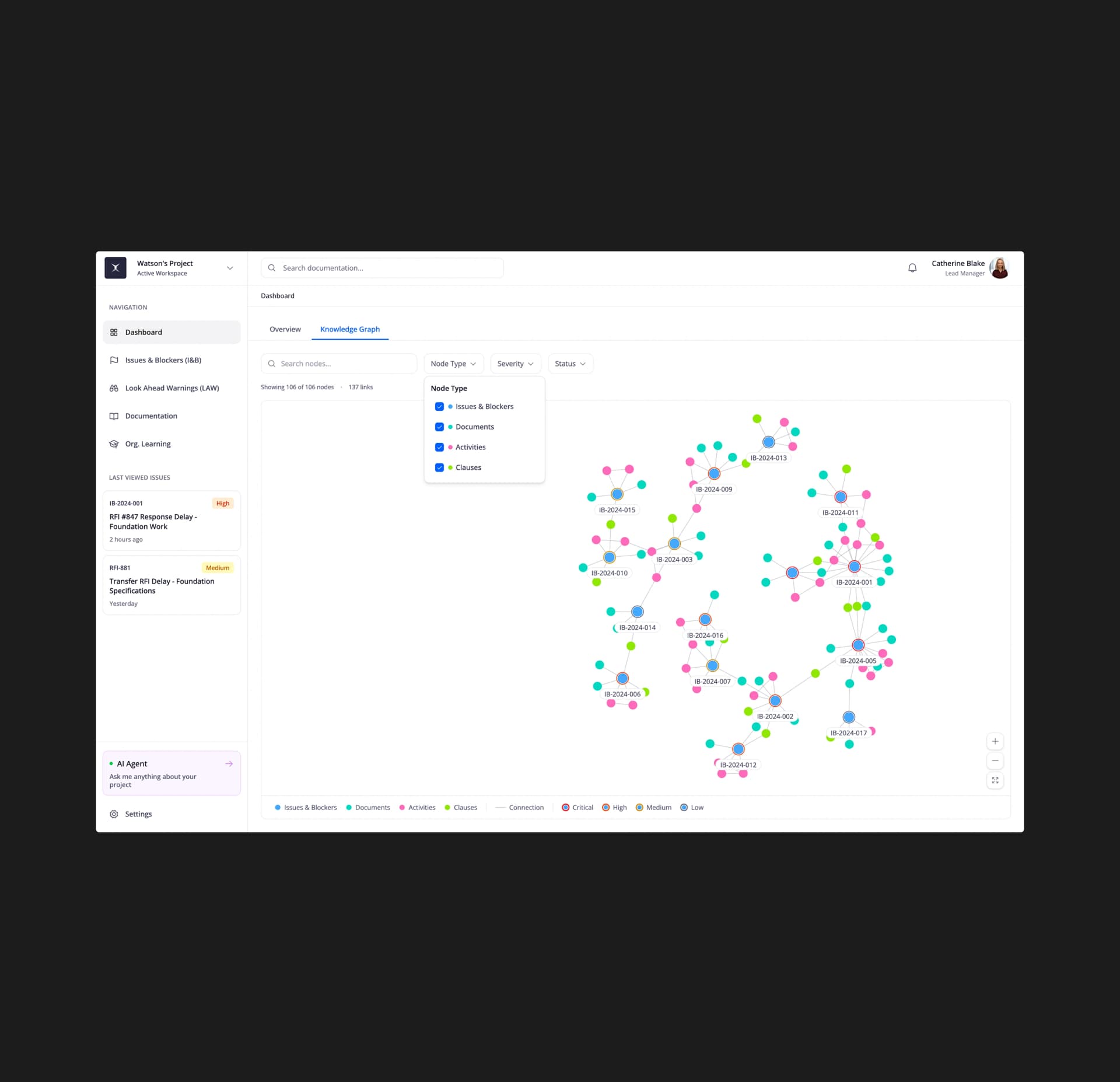
Dashboard — A real-time project health view built for the people who carry accountability across the whole build. KPI tracking, custom data visualisations, and a Knowledge Graph that maps relationships across issues, documents, and contracts — so a project manager can see not just what's happening on site, but what it connects to and what it means for the timeline.
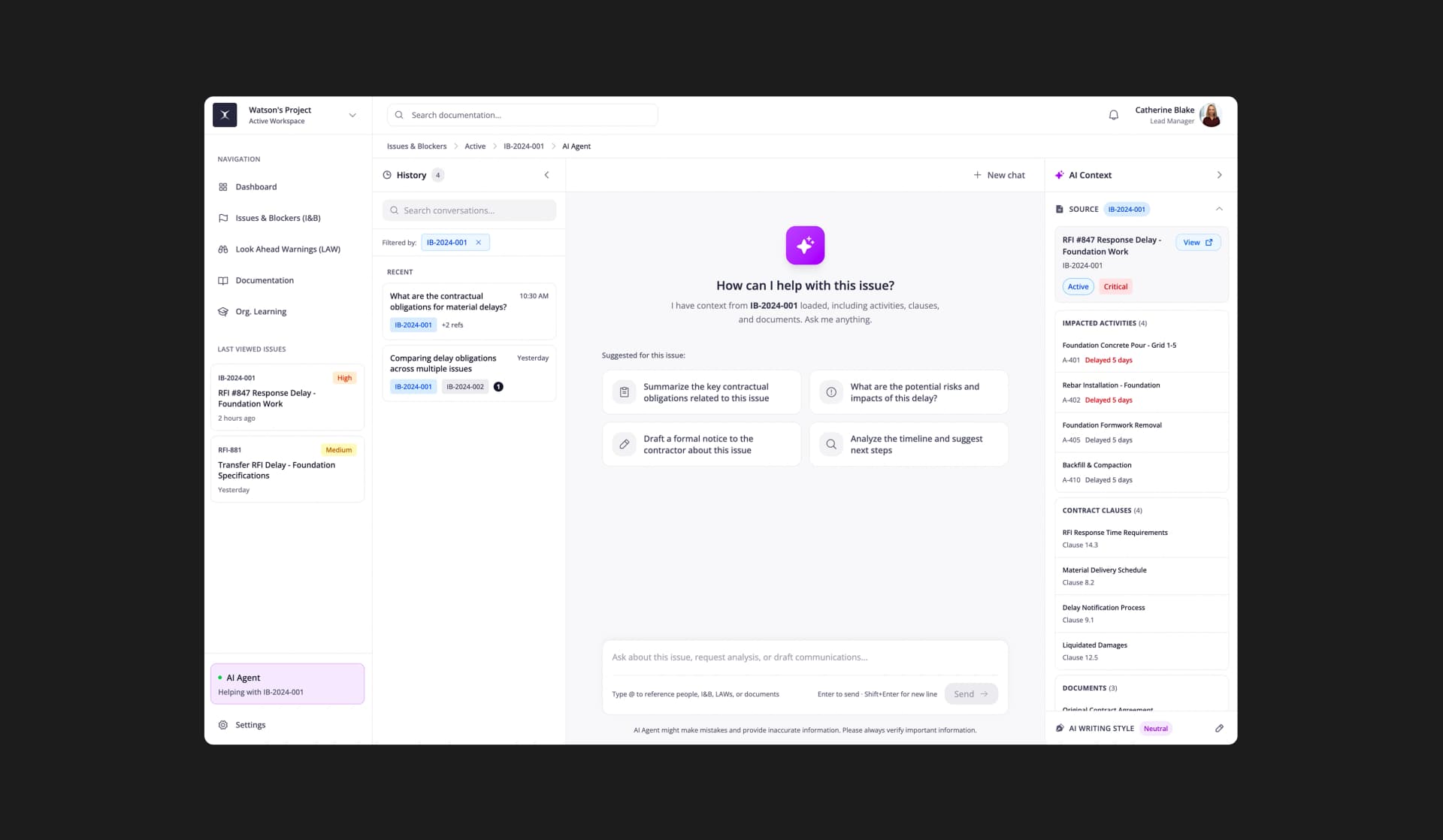
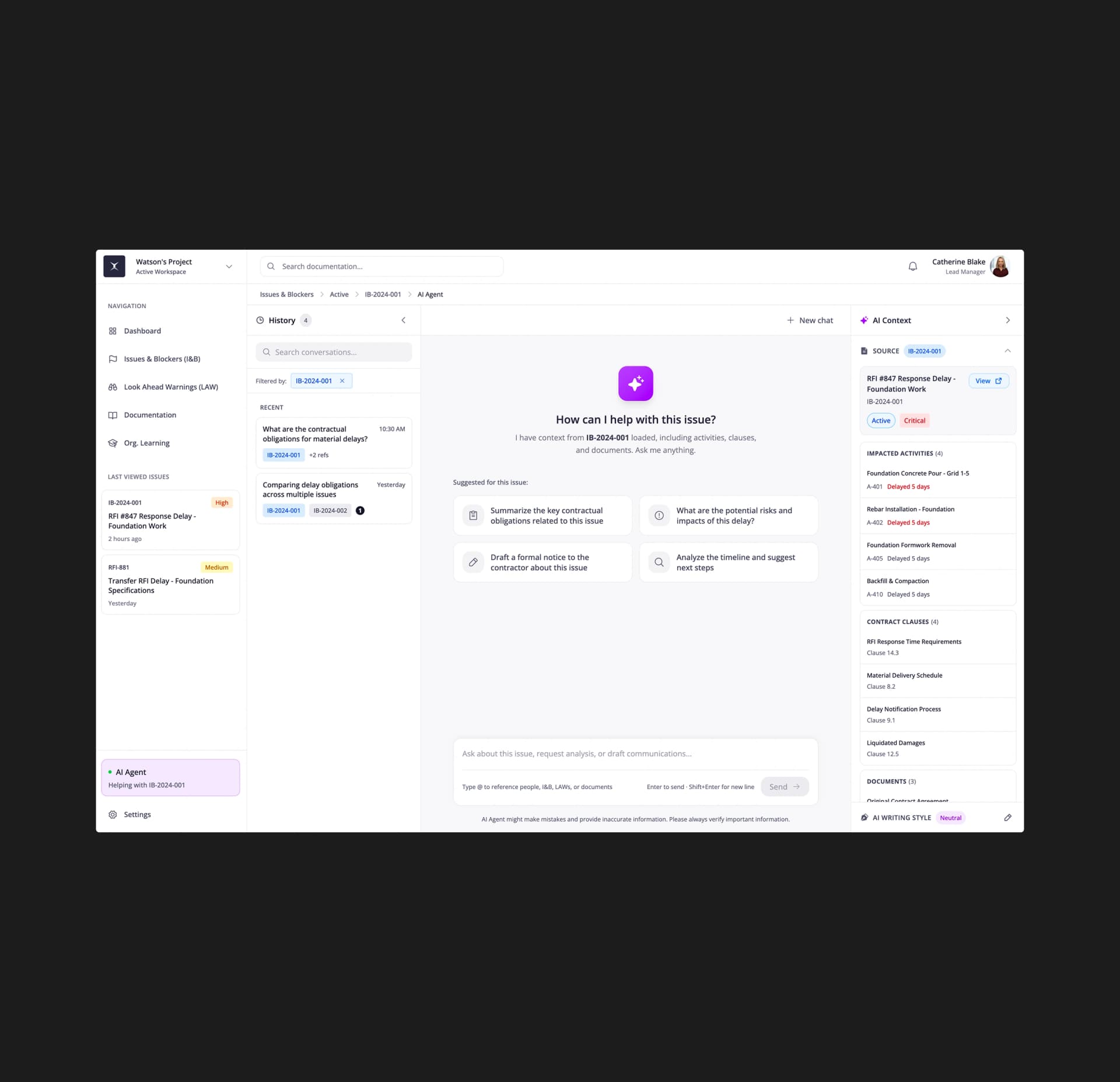
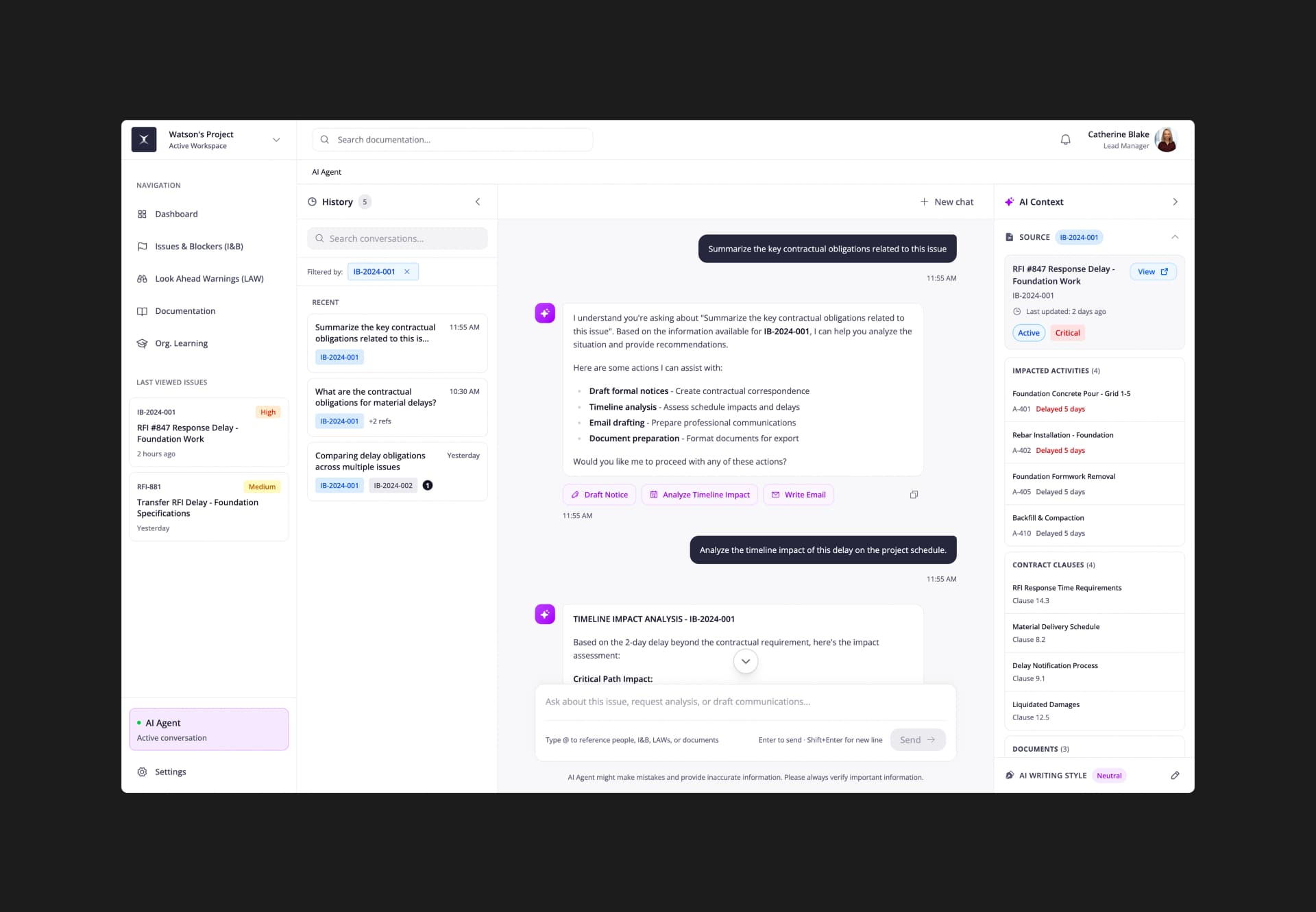
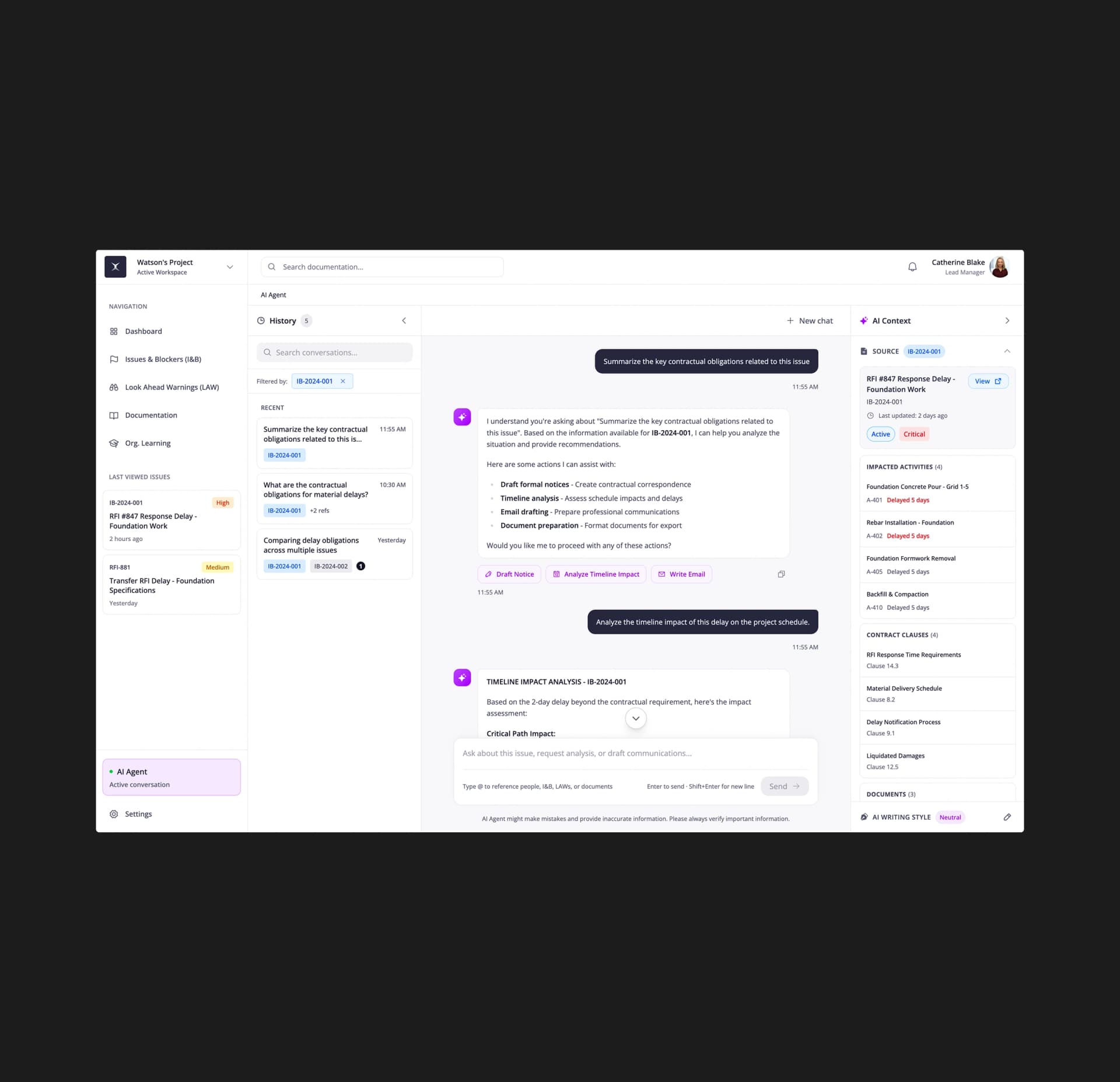
AI Agent — The product's core differentiator. The Agent doesn't surface documents — it completes steps in a workflow. Ask it to draft a formal response to a client letter: it cross-references the project's contract clauses, retrieves relevant prior correspondence, and produces a structured draft. Ask it to trace an issue: it maps the issue's origin and timeline and flags its contractual implications. Adjustable response styles, cross-referenced outputs, and a history panel that turns every past query into institutional knowledge.
The product is now in active development with the prototype as its foundation.